Trial Chambers & Mace Guide: Heavy Core & Math
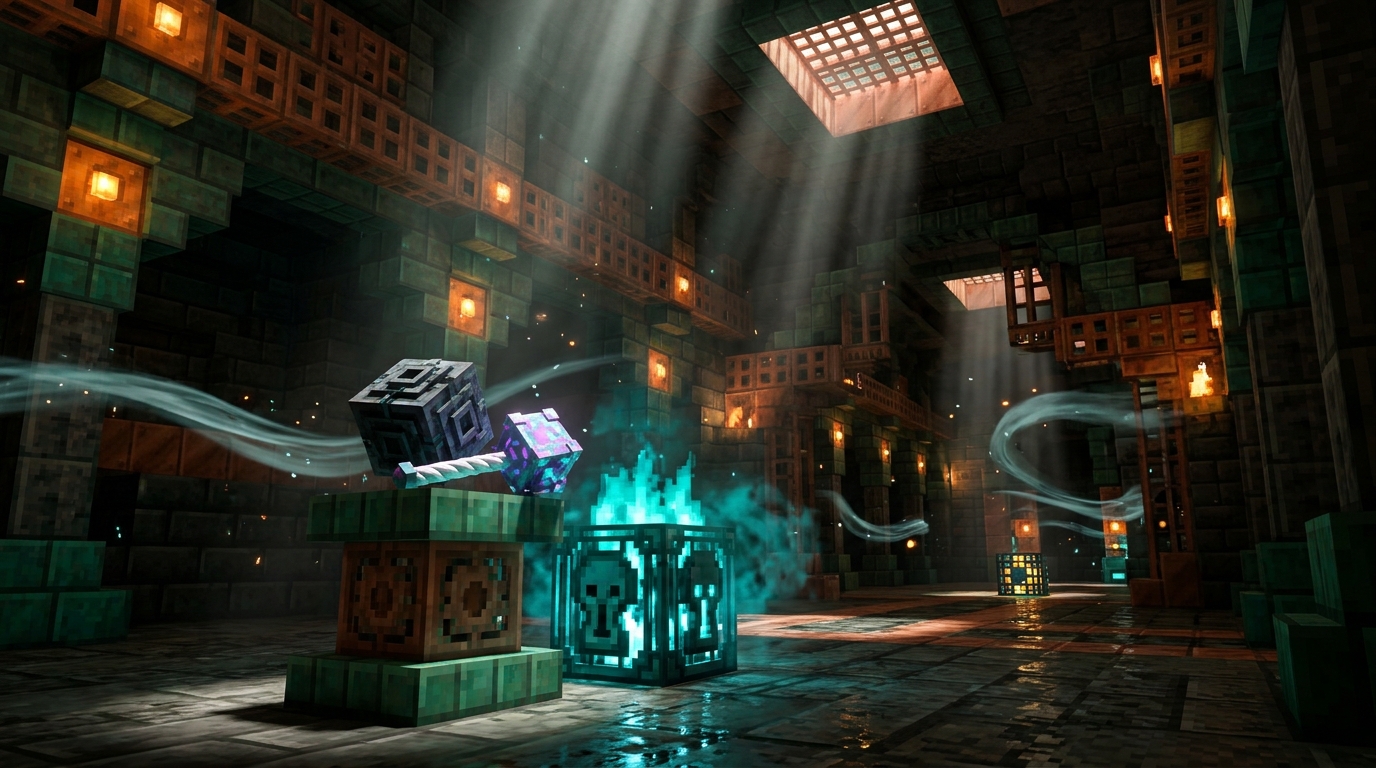
To obtain a Heavy Core (7.5% drop rate), drink an Ominous Bottle inside a Trial Chamber to convert Bad Omen into Trial Omen, defeat Ominous Trial Spawners for Ominous Trial Keys (~30% drop), and unlock Ominous Vaults. Craft the Mace from 1 Heavy Core + 1 Breeze Rod: falling over 1.5 blocks triggers a Smash Attack that negates fall damage and scales damage with Density V (+2.5/block) or bypasses 60% armor with Breach IV.
1. Trial Chambers Generation, Spawners & Vaults
Trial Chambers are sprawling copper-and-tuff underground complexes added in Minecraft 1.21 (Tricky Trials) that replace random dungeon grinding with deterministic, player-scaled combat arenas. Generating in the deepslate layer between Y = -40 and Y = 0 (most frequently around Y = -20), every chamber can be located reliably by trading for a Trial Explorer Map from a Journeyman Cartographer Villager.
Unlike traditional monster spawners that farm endlessly in dark rooms, Trial Spawners enforce strict pacing and anti-exploit rules:
- Player-Scaled Waves: Each Trial Spawner detects players within a 14-block radius. Base wave sizes increase by
+2mobs for every additional player present, keeping co-op raids balanced. - 30-Minute Cooldown: Once cleared, a Trial Spawner enters a
30-minute(36,000 game ticks) cooldown before it can be re-triggered. - Per-Player Vault Locks: Standard Vaults and Ominous Vaults track individual player UUIDs. Each player can unlock a specific Vault block exactly once—meaning SMP groups can all loot the same Vault, while solo players must explore multiple Trial Chambers to roll for rare drops.
2. Ominous Trials & the 7.5% Heavy Core Drop
Standard Trial Spawners drop regular Trial Keys (~50% chance) and never award the Heavy Core. To unlock the endgame loot table, you must trigger an Ominous Trial.
- Obtain an Ominous Bottle: Defeat Raid Captains at Pillager Outposts or Patrols (guaranteed drop, levels I–V) or loot regular Trial Vaults.
- Trigger Trial Omen: Drink the Ominous Bottle inside a Trial Chamber to gain Bad Omen, which immediately converts into Trial Omen lasting
15 minutes × bottle level. - Clear Ominous Trial Spawners: Nearby spawners ignite with blue soul flames, spawning armored skeletons, Bogged, Breezes, and melee mobs while dropping lingering potion hazards (Slowness, Weakness, Wind Charged, Weaving, Oozing) over the arena.
- Collect Ominous Trial Keys: Defeating an Ominous Trial Spawner grants roughly a 30% chance to eject an Ominous Trial Key.
| Loot Item (Ominous Vault) | Drop Chance | Primary Purpose | Notes & Trade-Off |
|---|---|---|---|
| Heavy Core | 7.5% | Crafts the Mace | Average ~13–14 Ominous Vaults per drop; 1–4 vaults per chamber |
| Wind Burst I Book | 5.5% | Vertical bounce on smash | Only obtainable from Ominous Vaults; combine 4 books for Level III |
| Density / Breach Books | ~2.8% – 5.5% | Mace damage / armor pierce | Also available via Enchanting Table and Librarian trades |
| Enchanted Golden Apple | ~22.5% | Emergency survival | Reliable supply for Hardcore and SMP boss fights |
| Flow Armor Trim / Banner | ~15% – 20% | Cosmetic customization | Unique to Trial Chambers copper-themed loot pools |
Crafting the Mace: Place 1× Heavy Core directly above 1× Breeze Rod in a Crafting Table. Breeze Rods drop exclusively from Breeze mobs (1–2 per kill, boosted by Looting III) inside the chambers, and can also be crafted into 4 Wind Charges each.
3. Mace Smash Damage Formula & Height Scaling
On a flat standing swing, the Mace deals 6 base damage (3 hearts) in Java Edition at a slow 0.6 attack speed—making it weaker than an unenchanted Diamond Sword. Its true power activates only during a Smash Attack, which triggers whenever you strike an entity while falling strictly more than 1.5 blocks.
Landing a Smash Attack completely negates your fall damage and knocks back nearby mobs in a 3.5-block radius. However, missing your swing leaves you unprotected against lethal fall damage—always carry a Water Bucket or Wind Charge as a fallback.
Total Damage = 6 + Fall Bonus + (Density Level × 0.5 × Fall Distance)
Where Fall Bonus scales in three tiers: +4/block for the first 3 blocks (max +12), +2/block for blocks 4–8 (max +22), and +1/block for every block beyond 8.
| Fall Distance (Blocks) | Base Mace Damage | With Density V (+2.5/block) | Notable One-Shot Threshold |
|---|---|---|---|
| 3 blocks (Wind Charge hop) | 18 (9 ♥) | 25.5 (12.75 ♥) | Unarmored Skeletons, Zombies, Creepers |
| 5 blocks | 22 (11 ♥) | 34.5 (17.25 ♥) | Witches, Piglin Brutes (partial) |
| 8 blocks (Wind Burst III peak) | 28 (14 ♥) | 48 (24 ♥) | Endermen (40 HP) and Armored Mobs |
| 15 blocks | 35 (17.5 ♥) | 72.5 (36.25 ♥) | Ravagers (100 HP with Strength II) |
| 25 blocks | 45 (22.5 ♥) | 107.5 (53.75 ♥) | Iron Golems (100 HP) |
| 50 blocks | 70 (35 ♥) | 195 (97.5 ♥) | Wither (300 HP in 2 hits); Warden (500 HP in 3 hits) |
4. Density vs Breach, Wind Burst & Anvil Order
The Mace introduces three exclusive enchantments, but strict mutual-exclusion rules force a clear build choice depending on whether you play PvE SMP or competitive PvP:
- Density (I–V) — Best for PvE & Bosses: Adds
+0.5damage per block fallen per level (+2.5/block at Density V). Mutually exclusive with Breach, Smite, and Bane of Arthropods. Unmatched for bursting Wardens, Withers, and Elder Guardians. - Breach (I–IV) — Best for Armored PvP: Reduces target armor effectiveness by 15% per level (up to 60% at Breach IV). Against a player wearing Protection IV Netherite armor, Breach IV from a modest 5–8 block drop deals significantly more post-mitigation damage than Density V.
- Wind Burst (I–III) — Aerial Combo Engine: Launches you upward after every Smash Attack, resetting your fall distance and letting you chain consecutive smashes mid-air. Note the trade-off: Wind Burst II–III launches you high enough that missing the next hit can cause severe fall damage unless you swap to Elytra or throw a Wind Charge.
💡 Anvil Prior Work Penalty Warning: Combining four Wind Burst I books alongside Density V (or Breach IV), Unbreaking III, Mending, and Fire Aspect II in the wrong order will trigger the dreaded "Too Expensive!" (40+ XP level) lock. Plan your exact tree-merge sequence in our Minecraft Enchantment & Anvil Calculator and review the binary pairing rules in our Anvil Prior Work Penalty Guide.
5. Wind Burst Combos & Java vs Bedrock Quirks
Mastering the Mace requires understanding how Wind Charges, Elytra, and edition-specific combat rules interact:
- Wind Charge Self-Boost: Throwing a Wind Charge straight down at your feet while jumping launches you ~7–8 blocks vertically—enough for an instant 34–48 damage Density V smash without building a dirt pillar.
- Elytra Dive Cancel: In Java Edition, gliding with Elytra and canceling flight right before impact preserves vertical momentum into a Smash Attack. Make sure you deactivate Elytra before swinging, or the smash bonus will not register reliably.
- Shield Counterplay (PvP): A raised Shield blocks a Mace Smash Attack completely and disables the defender's shield for 5 seconds—meaning you still negate fall damage on block, but deal zero HP damage.
- Java vs Bedrock Differences: Java enforces the
0.6attack cooldown (1.67 seconds for full recovery), whereas Bedrock allows faster swings while still requiring a >1.5-block fall to trigger Smash mechanics.
6. Key Combat & Farming Takeaways
- Never Waste Ominous Keys on Regular Vaults: Blue Ominous Keys only open Ominous Vaults; normal orange Trial Keys cannot roll the 7.5% Heavy Core table.
- Pick Density V for PvE, Breach IV for PvP: Density scales infinitely with height against unarmored bosses; Breach shreds Netherite Protection IV armor on low-altitude hops.
- Use Tree-Merging on the Anvil: Always pre-calculate Wind Burst I + I + I + I merges with our Enchantment Calculator to stay under the 39-level Anvil cap.
- Respect Chunk Boundaries: When building a multi-chamber search route or Raid Captain Ominous Bottle farm, verify spawn chunks and simulation borders with the Chunk Calculator.
7. Frequently Asked Questions (FAQ)
What is the exact drop rate of the Heavy Core in Minecraft 1.21+?
In Java Edition, an Ominous Vault has a 7.5% chance per unlock to eject a Heavy Core. Standard (non-ominous) Trial Vaults have a 0% chance to drop a Heavy Core.
Can I open the same Ominous Vault twice to farm Heavy Cores?
No. Every Vault and Ominous Vault stores the UUID of each player who unlocks it and allows only one roll per player forever. To keep rolling, you must locate additional Ominous Vaults in the same or new Trial Chambers.
Which is better on a Mace: Density V or Breach IV?
Use Density V for PvE, farms, and bosses (Warden, Wither, Ravagers) where targets lack heavy armor. Use Breach IV for PvP against players wearing Diamond or Netherite Protection IV armor, as ignoring 60% of armor value beats raw fall scaling at typical combat heights.
Does the Mace negate fall damage if I miss my target?
No. Fall damage is only negated if your Smash Attack successfully connects with a mob, player, or entity (including hitting a raised shield). Missing the swing results in full normal fall damage.
Does Mending work on the Mace, and can you repair it with Breeze Rods?
Yes, the Mace accepts both Mending and Unbreaking III. You can also repair a damaged Mace on an Anvil using Breeze Rods (each rod restores 25% durability), though Mending + Unbreaking III is far cheaper long-term.
📚 Related Technical & Survival Guides
Bypassing the Anvil "Too Expensive!" Cap: Binary Tree Combining Formula
Understand how Prior Work Penalty doubles XP costs (2ⁿ - 1) and how pairing Enchanted Books in a binary pyramid keeps maxed boots under 25 levels.
Minecraft Beacon Guide: Multi-Pyramids, Range, Powers & 75% Material Optimization
Master the mechanics of beacons in Minecraft 1.21+: calculate shared compound bases for 2×2 Quad and 6-Beacon setups, understand vertical sky cylinders, and leverage Haste II instant mining.
Why Minecraft Lags on Laptops: How to Boost FPS from 30 to 150+ (Sodium vs OptiFine 2026)
Comprehensive technical guide to fixing laptop stutters and boosting Minecraft 1.21+ FPS. Benchmarking Sodium vs OptiFine, discrete GPU forcing, JVM RAM allocation, and smooth 1% Lows.